

In the UAE’s high-velocity market, secure procurement isn't just a policy; it's a vital competitive shield. With the value of contracts awarded to Emirati SMEs reaching over AED 1.78 billion in 2025, the stakes for professional sourcing have never been higher. You've likely felt the pressure of verifying international partners or the fear of encountering fraudulent trade licenses that threaten your operations. It's a common challenge to manage these complexities while trying to scale in a global hub.
Ensuring the legitimacy of every commercial exchange is exhausting, yet it's the only way to protect your growth. This guide promises to help you master secure procurement for SMEs UAE through a professional framework designed for the 2026 landscape. We'll provide a repeatable vetting process and insights into using a pre-verified network to eliminate the manual headache of background checks. This checklist offers a clear roadmap to reduce operational risk and build a more resilient, growth-oriented business.
Key Takeaways
- Transition from informal sourcing to professional, verified supply chains to align with the UAE’s 2026 commercial standards.
- Identify the core pillars of supplier vetting, focusing on legal legitimacy and financial transparency to protect your operations.
- Evaluate the efficiency of platform-based sourcing compared to manual vetting to accelerate your time-to-market.
- Implement a repeatable, two-phase framework to master secure procurement for SMEs UAE and minimize fraud risks.
- Utilize a Verified Supplier Directory to gain immediate access to a vetted network and scale your business with confidence.
The State of SME Procurement Security in the UAE
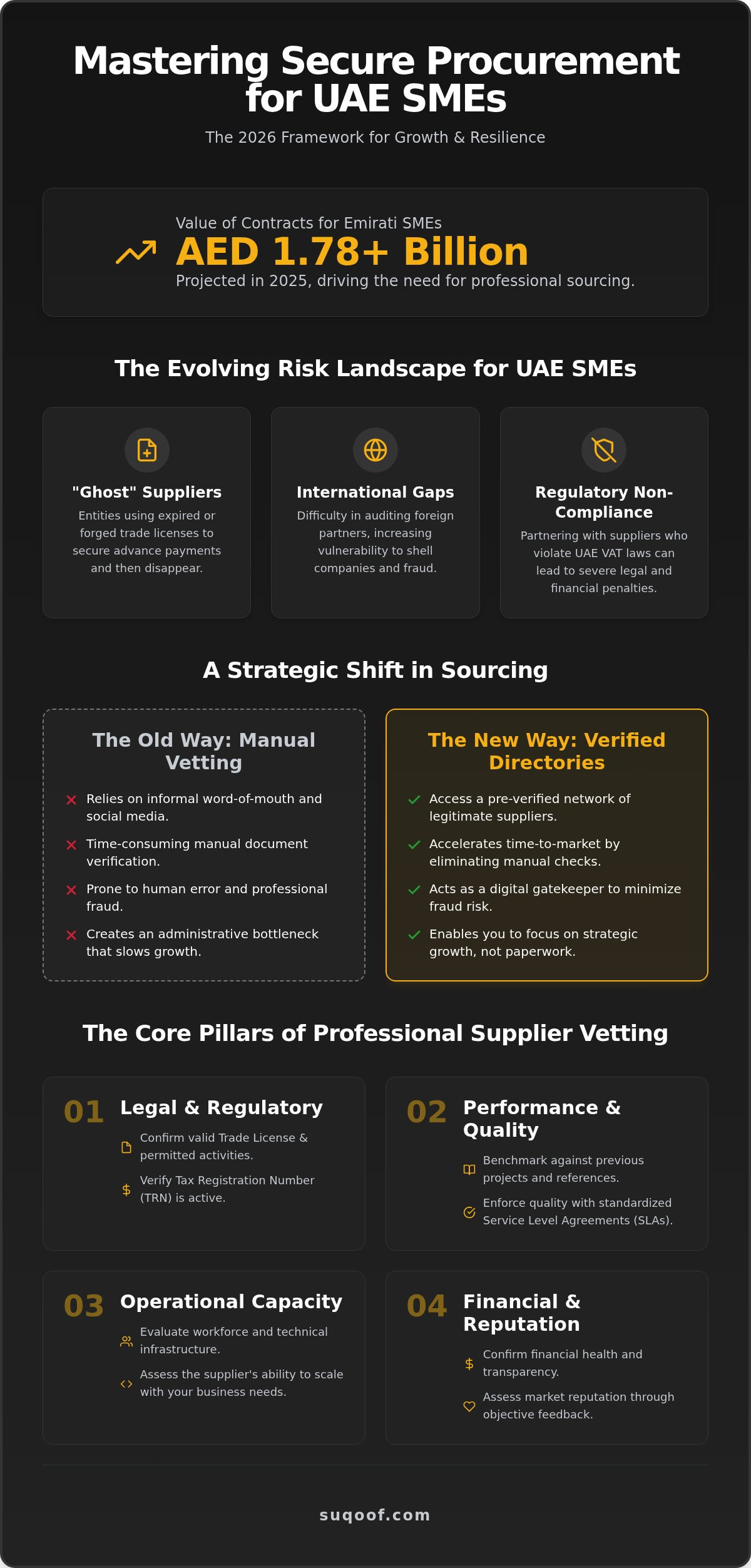
Secure procurement in the UAE involves more than just selecting a vendor; it's a rigorous alignment with national commercial standards and federal transparency laws. As the procurement process matures, 2026 marks a definitive shift away from informal, handshake-based agreements toward fully verified supply chains. This evolution is driven by the UAE's National Cybersecurity Strategy and the increasing digitalization of trade. For small and medium enterprises, adopting secure procurement for SMEs UAE is now a prerequisite for participating in a market where government-backed contracts for Emirati suppliers reached AED 1.78 billion in 2025.
The financial impact of procurement fraud can be devastating for smaller entities. Fraudulent activities often drain critical cash flow and disrupt project timelines. Mandatory corporate transparency is no longer optional. Businesses must verify the legal and financial standing of every partner to survive in this competitive environment. Strategic growth depends on your ability to filter out high-risk actors before they enter your ecosystem.
The Evolving Risk Landscape for UAE SMEs
The national market faces sophisticated B2B sourcing challenges that target the speed at which UAE businesses operate. Fraudsters often exploit the rapid growth of the commercial sector to insert themselves into legitimate supply chains. Common risks include:
- "Ghost" Suppliers: Entities that present expired trade licenses or forged documentation to secure advance payments.
- International Verification Gaps: The difficulty of auditing foreign partners from within the UAE increases vulnerability to shell companies.
- Regulatory Non-Compliance: Partnering with suppliers who don't follow UAE VAT laws can lead to significant legal and financial penalties for your business.
Why Traditional Sourcing Methods are Failing
Relying on social media groups or word-of-mouth recommendations is no longer a viable strategy for professional growth. These informal channels lack the oversight needed to detect professional fraud or regulatory non-compliance. Manual document verification is similarly flawed; it's time-consuming and prone to human error. For an SME looking to scale, the administrative burden of checking every license and VAT certificate manually creates a bottleneck. Modern secure procurement for SMEs UAE requires centralized, pre-verified directories. These platforms act as digital gatekeepers, ensuring that every participant meets high standards of legitimacy before a single dirham is exchanged.
Core Pillars of Professional Supplier Vetting
Professional vetting is the strategic foundation of any resilient business model. It transforms sourcing from a gamble into a calculated commercial decision. To achieve secure procurement for SMEs UAE, you must look beyond the surface of a corporate profile. True due diligence requires a deep dive into four critical areas: legal standing, financial health, operational capacity, and market reputation. Neglecting any of these pillars leaves your supply chain vulnerable to disruption and fraud.
Legal and Regulatory Compliance
Start with the trade license. It's the primary proof of a supplier's right to operate within the national framework. Use official registries to confirm the license is current and hasn't been suspended. Don't just look at the expiration date; verify the permitted commercial activities. If a supplier is licensed for general trading but provides specialized technical services, you're entering a high-risk zone. Tax compliance is the next vital step. Every legitimate partner should provide a valid Tax Registration Number (TRN). Verifying this through official channels ensures you aren't inadvertently facilitating tax evasion or partnering with an unregistered entity.
Performance and Quality Benchmarking
A valid license doesn't guarantee a quality outcome. You must benchmark performance through historical data and professional feedback. Request a list of previous projects that mirror your current requirements. Contact their references to ask about delivery consistency and communication styles. Standardized Service Level Agreements (SLAs) are your best tool for maintaining quality. These documents should clearly outline delivery timelines, quality benchmarks, and the consequences of failure. They turn vague promises into enforceable contracts that protect your interests. Managing this level of detail for every new partner is a massive drain on resources. Many successful firms now use a Verified Supplier Directory to bypass the initial screening phase and focus on strategic growth.
Operational capacity measures a supplier's ability to scale with your needs. Evaluate their current workforce and technical infrastructure before signing a contract. A supplier that's overextended is a liability, not an asset. Finally, assess reputational integrity. Market standing is often built over years of consistent service. Check professional networks and industry forums for feedback on their integrity. A supplier with a history of ethical business practices is a more secure choice for a long-term partnership. By focusing on these core pillars, you build a supply chain that isn't just functional but is also a secure platform for your company's expansion.
Manual Vetting vs. Verified Directories: A Strategic Comparison
Sourcing speed often dictates market leadership. In the UAE's high-stakes environment, manual vetting is no longer a sustainable strategy for growth. It creates a critical bottleneck that delays project kick-offs and resource allocation. Professional secure procurement for SMEs UAE requires a transition toward automated, high-trust platforms that prioritize speed without compromising on integrity. Choosing between an internal vetting team and a directory subscription is a decision that impacts your long-term scalability.
The Hidden Costs of Manual Procurement
Manual vetting is a significant resource drain. It mandates that your internal team spends countless man-hours collecting trade licenses, verifying VAT certificates, and checking references. This administrative load isn't just a nuisance; it's a strategic liability. A single oversight in document verification can lead to a "bad hire" within your supply chain. The cost of such a failure often exceeds the initial contract value due to legal complications and operational downtime. Manual processes effectively cap your company's agility. They prevent you from responding to new market opportunities because your procurement team is stuck in the verification phase.
The Advantage of Pre-Vetted Ecosystems
Pre-vetted ecosystems offer a decisive competitive edge. These platforms function as a sophisticated, outsourced due diligence department. When you utilize a Verified Supplier Directory, you bypass the preliminary screening phase entirely. You gain immediate entry into a network of high-trust commercial partners who've already cleared rigorous eligibility hurdles. This environment allows you to leverage platform authority to secure more favorable trade terms. Suppliers within these networks are often more willing to offer competitive pricing to buyers who are also part of a verified ecosystem. Using Buyer Marketplace Access ensures that every interaction occurs within a secure, professional framework.
Scalability is the final piece of the strategic puzzle. A directory-based approach allows an SME to enter a new sector or category in days rather than months. You don't need to hire new procurement specialists to vet vendors in an unfamiliar industry. The directory carries the primary burden of verification, shifting the operational risk away from your internal team. This model enables rapid expansion while maintaining the highest standards of professional integrity. It's a modern solution for businesses that value time as their most precious asset.
The 2026 SME Secure Procurement Checklist
A checklist converts strategy into action. It provides a methodical approach to identifying risks before they impact your balance sheet. This framework is the practical application of secure procurement for SMEs UAE; it ensures that every commercial connection is built on a foundation of verified data. To maintain a resilient supply chain, your team must execute a multi-phase due diligence process for every new engagement.
- Phase 1: Pre-Qualification. Filter candidates based on their core capabilities and alignment with your project requirements.
- Phase 2: Document Verification. Confirm the legal and tax standing of the entity through official national registries.
- Phase 3: Operational Due Diligence. Assess the supplier’s physical infrastructure and their ability to meet delivery timelines.
- Phase 4: Contractual Security. Establish clear Service Level Agreements and onboarding protocols that define performance expectations.
- Phase 5: Continuous Monitoring. Conduct periodic reviews to ensure the supplier remains compliant with evolving UAE regulations.
Step-by-Step Document Verification
Verification is your first line of defense against commercial fraud. It prevents high-risk actors from entering your ecosystem and protects your professional reputation. Don't accept digital copies without cross-referencing them with the issuing authority. A single forged document can lead to catastrophic operational failure.
- Valid Trade License: Ensure the license is active and the activity codes specifically match the services or goods being provided.
- VAT Certificate: Verify the Tax Registration Number (TRN) and check the latest filing status to ensure fiscal responsibility.
- Professional Indemnity Insurance: Confirm the supplier carries adequate liability coverage to protect your business from third-party claims.
Operational Assessment and Security
Operational security in 2026 requires a balance between digital protocols and physical reality. As trade becomes more digitized, the risk of cybersecurity breaches within the supply chain increases. You must verify that your partners adhere to the same security standards you maintain internally.
- Infrastructure Verification: Confirm the physical or virtual presence of the supplier’s office or warehouse to ensure they have the capacity to deliver.
- Cybersecurity Protocols: Review the methods used for data exchange to prevent unauthorized access to sensitive commercial information.
- AML and KYC Compliance: Perform Anti-Money Laundering and Know Your Customer checks to remain aligned with UAE federal transparency laws.
Implementing a standardized checklist for secure procurement for SMEs UAE protects your business from the volatility of unverified markets. To streamline this process and skip the manual administrative burden, access the Verified Supplier Directory to connect with partners who've already cleared these rigorous standards.
Optimizing Your Supply Chain with Suqoof
Suqoof acts as a definitive gatekeeper in the national trade landscape. It eliminates the ambiguity of unverified sourcing by establishing a high-trust environment for all participants. By utilizing the platform, you shift the burden of due diligence from your internal team to a professional system designed for commercial integrity. This is the most efficient method to implement secure procurement for SMEs UAE while focusing on your core business objectives. It transforms your supply chain from a potential liability into a verified asset for growth.
Streamlining Sourcing Through Verified Listings
The Verified Supplier Directory provides immediate access to vetted commercial entities across the UAE. Each listing undergoes a rigorous screening process to ensure legal and operational legitimacy. This single-source approach removes the need for fragmented manual searches and unreliable social media leads. Through Buyer Marketplace Access, you can engage with partners who already meet the high-trust standards required for modern commerce. It's a streamlined path to building a resilient supply chain without the traditional administrative delays. You gain the agility needed to respond to market shifts without compromising your security protocols.
Beyond Procurement: Building Strategic Partnerships
Strategic growth requires more than just transactions; it requires relationship management and network expansion. The Gifting Partner Program allows you to manage professional relationships with the same level of security and precision as your sourcing. This program helps maintain elite standards in corporate hospitality and gifting. Additionally, the Refer & Earn program provides a profitable way to grow your trusted network. By introducing other verified entities to the platform, you contribute to a more secure ecosystem while earning rewards for your company. This holistic approach ensures that your business doesn't just survive but leads in the competitive UAE market.
Secure your procurement today with Suqoof and join a network of professionals dedicated to commercial excellence and transparency. It's time to elevate your sourcing standards and protect your path to global expansion.
Future-Proof Your Supply Chain for 2026
Mastering the complexities of B2B sourcing is no longer an optional administrative task; it's a strategic necessity for survival in the UAE's elite commercial landscape. By shifting from inefficient manual vetting to a professional framework, you protect your capital and ensure long-term scalability. Implementing secure procurement for SMEs UAE through a structured 5-phase checklist allows you to bypass fraudulent trade licenses and mitigate supply chain disruptions effectively. It's time to transition toward a model that prioritizes legitimacy and speed.
Suqoof acts as your diligent gatekeeper, offering a strictly vetted network that removes the uncertainty from every commercial exchange. You can now leverage professional Buyer Marketplace Access and comprehensive Verified Supplier and Host Directories to build a high-trust environment for your business. These tools provide the structural clarity needed to make informed decisions and advance your corporate goals with total confidence. Access the Verified Supplier Directory and Secure Your Sourcing to eliminate operational risk today. Your path to professional advancement starts with connections you can trust.
Frequently Asked Questions
What is secure procurement for SMEs in the UAE?
Secure procurement for SMEs in the UAE is a strategic framework designed to verify every supplier's legal, financial, and operational legitimacy. It involves aligning with national commercial regulations to mitigate risks like fraud or supply chain disruptions. Implementing secure procurement for SMEs UAE ensures that every transaction occurs within a high-trust environment, protecting your company's capital and professional reputation. It's about shifting from informal sourcing to professional, data-driven verification processes.
How do I verify a supplier’s trade license in the UAE?
You verify a supplier's trade license through the National Economic Register (NER) or the specific licensing authority's official portal. Check that the license is currently active and that the listed commercial activities match the specific services being provided to your business. Don't rely on digital copies alone; always cross-reference the license number to confirm it hasn't been suspended. This step is a fundamental component of professional due diligence in the national market.
Why should SMEs avoid unverified B2B marketplaces?
SMEs should avoid unverified B2B marketplaces because they often lack the rigorous gatekeeping needed to filter out fraudulent entities or "ghost" suppliers. These platforms expose your business to high risks of financial loss and sensitive data breaches. Without a pre-vetted network, the burden of verification falls entirely on your internal team, which is both time-consuming and prone to human error. Professional directories provide a secure alternative by ensuring all participants meet strict eligibility standards.
What are the red flags of a fraudulent supplier?
Key red flags include trade licenses with mismatched activity codes, a lack of a valid Tax Registration Number (TRN), or requests for full advance payments to unofficial bank accounts. Be wary of suppliers who cannot provide verifiable professional references or physical office locations. If a deal seems significantly below market rates without a clear reason, it often indicates a high risk of project failure or commercial fraud. Always verify documentation through official national registries.
How does a verified directory save time for procurement managers?
A verified directory acts as an outsourced due diligence team, providing immediate access to pre-screened partners across the country. It eliminates the man-hours usually spent on document collection and manual verification of trade licenses and VAT certificates. Procurement managers can skip the preliminary screening phase and focus on negotiating trade terms and strategic scaling. This efficiency accelerates the time-to-market and allows SMEs to enter new sectors rapidly without increasing their administrative overhead.
Can I use secure procurement strategies for international sourcing?
You can certainly apply these strategies to international sourcing. Secure procurement for SMEs UAE involves applying the same rigorous vetting standards to international partners as you do for domestic ones. You should verify global entities through official trade registries and request localized compliance documentation. Utilizing a platform with a strictly vetted network helps bridge the trust gap when dealing with overseas manufacturers. This approach ensures that international sourcing remains secure and transparent.
What documents should I request from a new UAE supplier?
You must request a valid Trade License, a VAT Registration Certificate, and evidence of professional indemnity or liability insurance. It's also professional practice to ask for a corporate profile that includes verifiable case studies or past performance references. Ensure you receive the latest tax filing status to confirm the entity's financial responsibility. These documents form the baseline for your operational and commercial due diligence process during the supplier onboarding phase.
Is VAT registration mandatory for all suppliers on a verified directory?
VAT registration depends on the supplier's annual turnover as per Federal Tax Authority (FTA) regulations, but a verified directory prioritizes transparency. Most professional directories require a valid Tax Registration Number (TRN) to ensure the supplier is a legitimate commercial entity. Verifying VAT compliance is a critical step in protecting your business from legal complications. It ensures that your partners are fully integrated into the UAE's formal economic system and meet national standards.


