

What makes a referral valuable: the reward, or the trust behind the introduction? A refer and earn program can recognise a recommendation, but its value depends on more than an incentive. In hospitality, a thoughtful connection matters: guests, hosts and suppliers need introductions that are relevant to their needs.
If you’re weighing up a referral programme, it helps to understand how it differs from affiliate marketing and lead generation. Referral programmes centre on introductions between people, while other models may focus on promoting an offer to an audience or contacting prospective customers directly. Clear rules, relevant recommendations and respect for the relationship help make any referral more useful.
This guide explains the basic model, what to consider before making a professional referral, and how Suqoof’s Refer & Earn Program fits into a hospitality platform connecting guests, hosts and suppliers. The lasting value of a referral starts with a credible connection.
Key Takeaways
- Understand how a refer and earn program connects a participant with a relevant person under stated programme rules.
- Look for clear eligibility, attribution and reward terms when assessing a programme.
- Compare referral marketing with affiliate marketing by considering the relationship, promotional action and programme structure.
- Make business referrals responsibly by identifying a relevant need, seeking permission and introducing both parties clearly.
- See how Suqoof’s Refer & Earn Program supports connections within a hospitality platform for guests, hosts and suppliers.
What Is a Refer and Earn Program, and How Does It Work?
How does a referral become more than a name passed along? A refer and earn program is an arrangement in which a participant introduces a relevant person or business under stated programme rules. The rules explain what counts as a referral and whether a reward or other recognition applies.
In practice, someone recognises a potential fit and connects two parties, often because they know one side or understand a shared need. For example, a host looking for a service provider might welcome an introduction to a supplier whose work is relevant. Rather than simply forwarding contact details, the referrer can explain why the connection may help and let both parties decide whether to follow up.
Referral marketing describes the broader practice of encouraging recommendations and introductions. A referral differs from paid advertising, which presents a promotional message to an audience, and from unsolicited lead generation, which gathers or approaches prospective contacts without necessarily relying on a trusted introduction. A referral works best when it is relevant and welcome.
How is a referral programme different from affiliate marketing?
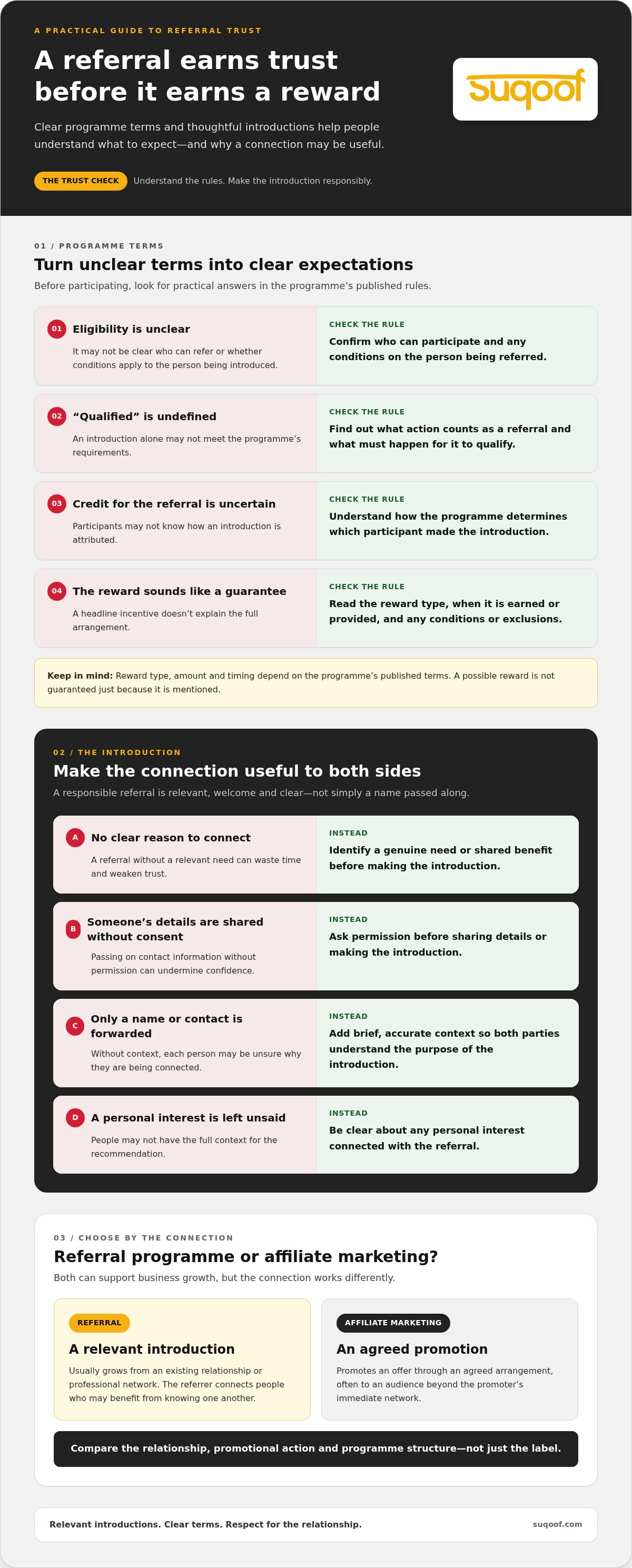
A referral usually grows from an existing relationship or professional network. The referrer connects people who may benefit from knowing one another. Affiliate marketing, by contrast, involves promoting an offer through an agreed arrangement, often to an audience beyond the promoter’s immediate network. Both can support business growth, but they rely on different kinds of connection. Compare how each model works, rather than assuming the label explains its terms.
Who may take part in a refer-and-earn programme?
Depending on its rules, a programme may invite customers, members, professionals or other participants to make relevant introductions. Eligibility can differ between programmes, so the rules determine who can take part and what qualifies as a referral.
Good introductions also depend on judgement and consent. Consider whether there’s a genuine need, ask permission before sharing someone’s details, and make the purpose of the connection clear to both parties. Suqoof’s hospitality platform brings together guests, hosts and suppliers. It also connects suppliers with verified job requests from guests and hosts, while giving hosts access to an on-platform supplier marketplace. These connections provide the wider context for Suqoof’s Refer & Earn Program.
What Makes a Refer and Earn Program Trustworthy?
A referral should create a useful connection, not just an opportunity to claim a reward. A trustworthy refer and earn program explains its terms clearly, so participants can make an informed decision before taking part. When people understand what qualifies and what to expect, they can recommend the programme with greater confidence.
Transparent rules build participant confidence. Clear terms prevent misunderstandings about who can participate, how an introduction is attributed and when a referral meets the programme’s conditions. They also help participants judge whether the arrangement suits them without treating a possible reward as guaranteed.
Which programme terms should participants understand?
Before taking part in a referral programme, look for answers to practical questions such as:
- Eligibility: Who can make a referral, and are there any conditions on the person being introduced?
- Qualification: What action counts as a referral, and what must happen for it to qualify?
- Attribution: How does the programme determine which participant made the introduction?
- Reward terms: What type of reward applies, and when is it earned or provided?
The reward type, amount and timing depend on the programme’s published terms. Read those terms as a whole, including any conditions or exclusions. A headline incentive alone won’t explain how the programme works.
These are useful criteria for evaluating referral programmes generally. Suqoof’s Refer & Earn Program is part of its wider hospitality platform, where guests, hosts and suppliers connect through services and marketplace access. Understand the programme as one element of that network, rather than assuming it follows the rules of another referral scheme.
How can a programme encourage genuine introductions?
Start with relevance. A referral is more useful when there’s a clear reason the two parties may benefit from connecting. Add brief, accurate context so each person understands why the introduction is being made. This helps both sides decide whether to continue the conversation.
Permission matters, too. Ask before sharing someone’s contact details or introducing them, and be clear about any personal interest in the referral. Sending a list of names without consent or context is not the same as making a considered introduction. It can waste time and weaken trust, even if a programme offers a reward.
Suqoof’s hospitality platform connects guests, hosts and suppliers, with supplier marketplace access for hosts and verified job requests for suppliers. Those connections are the setting for its referral initiative: relevant introductions can help people discover services and professional opportunities within the wider hospitality ecosystem.
Refer and Earn Program vs Affiliate Marketing: Which Model Fits?
The right approach depends on the relationship you want to create. A refer and earn program centres on a relevant introduction, while affiliate marketing and outbound outreach connect businesses with people in different ways. Choose by considering your goal, audience and the kind of connection you want to make.
| Approach | Relationship | Typical action | General structure |
|---|---|---|---|
| Referral | An existing personal or professional connection | Introduces two parties who may have a relevant need | Participation and any recognition follow the programme’s terms |
| Affiliate marketing | A promoter connects an offer with an audience | Shares or promotes an offer through an agreed arrangement | Terms define the promotional arrangement and any applicable reward |
| Outbound outreach | A direct approach to a prospective contact | Contacts someone to introduce an offer, service or business opportunity | Organised around prospecting and follow-up, rather than a personal referral |
When is a referral-led approach a natural fit?
A referral can suit situations where someone knows both sides well enough to recognise a potential match. For example, a host who knows a supplier’s work may introduce that supplier to another host with a related need. The context matters: explaining why the connection could be useful gives each person a clearer reason to engage.
In professional networks and marketplaces, relevance matters more than the number of names passed along. A considerate introduction respects both parties’ time and helps them decide whether to continue. It can open a conversation, but it doesn’t guarantee a booking, contract or other business result.
When might affiliate marketing or outreach be different?
Affiliate marketing may suit a business seeking to promote an offer to an audience through an agreed arrangement. The promoter doesn’t necessarily need a personal relationship with every potential customer. The arrangement’s terms shape how the activity is carried out.
Outbound outreach is different again. It involves directly approaching prospective contacts, rather than connecting them through a mutual relationship. It can be appropriate when a business needs to start conversations with people who may not already be in its network. Consider whether your priority is a trusted introduction, audience promotion or direct prospecting, then choose the model that fits that purpose.
Suqoof brings guests, hosts and suppliers together through its hospitality platform, with an on-platform supplier marketplace for hosts. This creates a setting for relevant professional connections. Its Refer & Earn Program is part of that wider network, alongside services for guests and hosts.
How to Make a Useful, Responsible Business Referral
A strong business referral is precise, permission-based and easy for both parties to act on. These steps can help you make a professional introduction that respects people’s time and gives them the context to decide whether to connect. If you take part in a referral programme, follow its rules.
How do you make an introduction useful to both sides?
Begin with the need, not the reward. Identify what one person is looking for and why the other may be relevant. Ask each party for permission before sharing contact details or making an introduction. This gives both people control over whether they want to connect.
Keep the introduction short and factual. For example, you might tell a host seeking a particular service that you know a supplier whose work may be relevant. Don’t claim the supplier is available, the ideal choice or certain to deliver a particular result. Give enough context to explain the possible fit, then let both parties assess it themselves.
A useful introduction typically includes:
- The shared context: Briefly explain the need or common interest.
- A clear reason: State why you think the connection may be relevant.
- Consent: Confirm both parties are comfortable being introduced.
- Room to decide: Let them choose whether to continue the conversation.
For broader context on how businesses use online marketplaces to connect, read this B2B marketplace guide for UAE companies. A marketplace can help businesses discover relevant connections, while a personal referral adds context about why two participants might benefit from speaking.
How should participants follow up without pressure?
After making the introduction, offer a simple next step, such as inviting the two parties to arrange a conversation directly. If appropriate, follow up once to ask whether the connection was useful, then respect their response. No reply or a decision not to proceed is a signal to step back.
Keep messages relevant and transparent. Explain your relationship to the people involved and any interest you have in making the referral. Don’t send repeated prompts, imply that a business outcome is guaranteed or make claims you can’t substantiate. The aim is to open a door, not push someone through it.
How Suqoof's Refer & Earn Program Fits Its Hospitality Platform
Suqoof offers a Refer & Earn Program as part of its web and mobile hospitality platform. The wider platform connects guests, hosts and suppliers, bringing professional relationships into an ecosystem centred on stays and hospitality services. The programme supports network growth within this connected setting.
How does the referral initiative relate to Suqoof's ecosystem?
Each group has a distinct place in the platform. Guests can book stays, add experiences such as tours or dining, and pre-arrange hospitality services. Hosts can set up, list and manage properties, add services for guests, and access a marketplace of suppliers. Suppliers can receive verified job requests from guests and hosts and connect with property owners.
The referral initiative is one part of that wider environment. It sits alongside the connections the platform facilitates, rather than promising a particular booking, supplier job or business result. The supplier marketplace helps hosts discover services, while the Refer & Earn Program supports network expansion through referrals.
For more background on supplier networks and how directories can support business discovery, read this verified supplier directory guide. It offers additional context for understanding the supplier side of a hospitality ecosystem, while a referral is a separate way to connect people.
What can readers explore next?
If your interest is in how trusted connections relate to hospitality, consider the needs of each group: guests look for suitable stays and experiences, hosts manage accommodation, and suppliers respond to relevant work opportunities. Seeing these roles together makes it easier to understand the platform’s broader purpose. Suqoof’s Refer & Earn Program is part of this connected setting.
Explore Suqoof’s hospitality platform to discover its connected guest, host and supplier ecosystem.
Build Better Connections Through Thoughtful Referrals
A refer and earn program is most valuable when its rules are clear and its introductions are relevant. Understanding how referrals differ from affiliate marketing and outreach helps you choose the approach that suits your goal. In any professional introduction, seek permission, give both parties accurate context and let them decide whether to continue.
Suqoof offers a Refer & Earn Program within a hospitality platform connecting guests, hosts and suppliers. The platform also helps suppliers connect with verified job requests from guests and hosts, bringing professional relationships into a wider hospitality ecosystem.
Explore Suqoof’s hospitality platform to discover how its connected community brings these groups together. Find stays, experiences and hospitality services in one place, and make your next connection thoughtfully.
Frequently Asked Questions
What is a refer and earn program?
A refer and earn program is an arrangement where a participant introduces a person or business to an organisation under stated rules. If the introduction meets those rules, the programme may provide a specified reward. Conditions differ by programme, so participation alone doesn’t ensure a referral qualifies or a reward will be earned. Read the terms to understand what applies before taking part.
How does a refer and earn program work?
A typical referral journey begins when someone identifies a relevant person, shares an introduction through the programme’s stated method, and the referred person takes any qualifying action. The published terms determine who can participate, what counts as a valid referral, how it is attributed and whether a reward applies. They also set any reward conditions and timing. Review these details first, as programmes can define each stage differently.
Is a refer and earn program the same as affiliate marketing?
No. A referral programme generally centres on an introduction through an existing personal or professional relationship. Affiliate marketing generally involves promoting an offer to an audience through an agreed arrangement, whether or not the promoter knows each potential customer. The distinction is about how people are connected, not a universal set of reward rules. Terms vary, so consider the structure of the specific programme rather than relying on its label alone.
Can businesses use refer and earn programs to grow their networks?
Yes. Relevant introductions can help businesses discover people or services that may fit a particular need. For instance, a business owner could introduce a colleague seeking a supplier to a supplier whose work appears relevant, with both parties’ permission. The introduction creates an opportunity to start a conversation, not a guaranteed lead, conversion or source of revenue. Its usefulness depends on context, consent and the parties’ interest in continuing.
What should I check before joining a refer and earn program?
Read the programme rules before sharing a referral. Look for who can participate, what qualifies, how the referral is attributed, and any reward conditions and timing. Also consider what personal information you may need to share, how it will be used, and whether the person you’re referring has agreed to the introduction. Clear terms help you understand the arrangement, but each programme sets its own requirements.
Does Suqoof have a Refer & Earn Program?
Yes. Suqoof offers a Refer & Earn Program within its hospitality platform, which connects guests, hosts and suppliers. Suppliers can receive verified job requests from guests and hosts, while hosts can access an on-platform supplier marketplace. The programme sits within this wider ecosystem, connecting referral activity with Suqoof’s hospitality network.
Disclaimer
Information in this article is provided for general informational purposes and may change over time. Prices, availability, policies, opening hours and other details may vary. We recommend confirming relevant information directly with the applicable provider or authority before making travel or booking decisions.


